
In today’s competitive market, companies are always looking for ways to cut operational expenses while maintaining a high level of service quality. “Warehouse and distribution management is one of the biggest cost centers in any supply chain.
Inefficiencies in warehouse distribution can quickly increase logistics costs, from storage and inventory handling to order fulfilment and last-mile delivery. This is where smart warehouse distribution solutions are key.
In Australia, businesses can cut costs and increase overall supply chain performance by using technology, data-driven strategies and integrated logistics systems.
In this blog, we will discuss how smart warehouse distribution solutions help businesses reduce costs, enhance efficiency, and scale operations effectively.
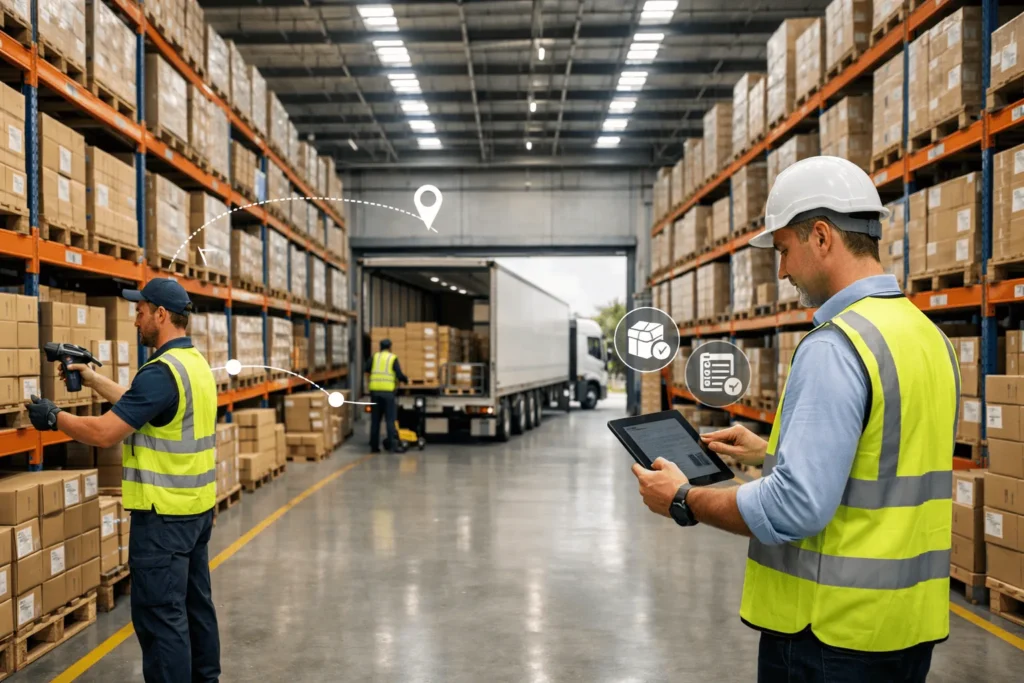
What Are Smart Warehouse Distribution Solutions?
Smart warehouse distribution is the application of modern technologies and optimised processes for efficient storage, inventory and distribution management.
The solutions are:
- Warehouse Management Systems (WMS)
- Systems for control of inventory
- Automated packing & picking
- Route Optimisation Tools.
- Integrated planning of transport and distribution
These systems collaborate to develop an efficient logistics network with minimum waste and maximum efficiency.
1. Optimize Inventory Management to Reduce Holding Costs
Poor inventory management leads to:
- Overstocking
- Stockouts
- Increased storage costs
- Capital being tied up in unsold goods
Smart inventory systems provide:
- Real-time stock visibility
- Demand forecasting
- Automated replenishment
- Inventory turnover analysis
By maintaining optimal stock levels, businesses can reduce warehousing costs and improve cash flow.
2. Use Warehouse Management Systems (WMS)
A Warehouse Management System (WMS) is essential for efficient operations.
It helps in:
- Tracking inventory in real time
- Managing storage locations
- Optimizing picking routes
- Reducing manual errors
WMS improves operational efficiency and reduces labour costs, making it a key component of smart warehouse distribution solutions in Australia.
3. Improve Warehouse Layout and Space Utilization
An inefficient warehouse layout leads to:
- Longer picking times
- Increased labour effort
- Poor space utilization
Smart distribution centers use:
- Optimized aisle design
- High-demand product placement
- Vertical storage systems
- Slotting strategies
Better layout planning reduces handling time and increases storage capacity without additional costs
4. Automate Picking, Packing, and Sorting
Manual processes are time-consuming and error-prone.
Automation tools such as:
- Barcode scanners
- RFID systems
- Conveyor belts
- Automated sorting systems
help reduce errors and improve speed.
Automation reduces labour dependency and lowers operational costs while improving order accuracy.
5. Integrate Warehouse and Transport Systems
One of the biggest cost-saving opportunities lies in integrating warehouse operations with transport systems.
Benefits include:
- Faster dispatch coordination
- Reduced truck waiting time
- Optimized delivery scheduling
- Better route planning
Integrated transport and logistics solutions in Australia ensure smooth movement of goods from warehouse to customer.
6. Reduce Last-Mile Delivery Costs
Last-mile delivery is one of the most expensive parts of logistics.
Smart distribution solutions help by:
- Optimizing delivery routes
- Grouping shipments (consolidation)
- Using real-time tracking
- Improving delivery accuracy
Reducing delivery failures and re-attempts significantly lowers overall logistics costs.
7. Leverage 3PL Warehouse Distribution Services
Outsourcing to 3PL warehousing and distribution providers in Australia can reduce costs by:
- Eliminating infrastructure investment
- Providing scalable storage
- Offering experienced workforce
- Using advanced logistics technology
3PL providers help businesses focus on core operations while ensuring efficient supply chain management.
8. Use Data Analytics for Continuous Improvement
Modern warehouse systems generate valuable data.
Businesses can analyze:
- Order processing time
- Inventory turnover rates
- Delivery performance
- Cost per shipment
Data-driven insights help identify inefficiencies and optimize operations for long-term cost savings.
9. Minimize Returns and Reverse Logistics Costs
Returns can significantly increase logistics costs.
Smart warehouse distribution improves:
- Order accuracy
- Packaging quality
- Delivery reliability
This reduces return rates and associated costs.
Efficient reverse logistics systems also help recover value from returned products.
10. Improve Workforce Productivity
Labour costs are a major part of warehouse operations.
Smart solutions improve productivity by:
- Streamlining workflows
- Reducing manual tasks
- Providing digital task management tools
- Enhancing training through automation
Higher productivity means lower cost per order and improved efficiency.
Industries That Benefit from Smart Warehouse Distribution
- E-commerce businesses
- Retail chains
- FMCG companies
- Manufacturing industries
- Import-export businesses
All these sectors rely heavily on efficient warehouse and distribution services in Australia.
Key Benefits of Smart Warehouse Distribution Solutions
✔ Reduced operational costs
✔ Faster order fulfilment
✔ Better inventory control
✔ Improved delivery efficiency
✔ Enhanced customer satisfaction
✔ Scalable logistics operations
Conclusion
Reducing costs in logistics is not about cutting corners — it’s about working smarter.
By adopting smart warehouse distribution solutions, businesses in Australia can optimize inventory, automate operations, improve delivery efficiency, and reduce overall supply chain costs.
Whether through technology, better planning, or outsourcing to professional logistics providers, smart distribution strategies are essential for sustainable business growth.
In today’s competitive environment, efficient warehouse and distribution management is not just an advantage — it’s a necessity.
Frequently Asked Questions
Q1. What is smart warehouse distribution?
It uses technology and optimized processes to improve storage, inventory, and delivery efficiency.
Q2. How can warehouse distribution reduce costs?
By improving inventory control, reducing labour, and optimizing delivery routes.
Q3. What is a Warehouse Management System (WMS)?
It is software that manages inventory, storage, and warehouse operations.
Q4. Can small businesses use smart warehouse solutions?
Yes, especially through 3PL services that offer scalable solutions.
Q5. Why is last-mile delivery expensive?
Because it involves individual deliveries, fuel costs, and higher operational complexity.
Lorem ipsum dolor sit amet, consectetur adipiscing elit. Ut elit tellus, luctus nec ullamcorper mattis, pulvinar dapibus leo.