
The Australian freight and logistics industry is experiencing a major technological transformation. As businesses demand faster deliveries, lower transportation costs, improved efficiency, and better customer experiences, logistics companies are increasingly turning to Artificial Intelligence (AI) to modernize their operations. From route optimization and predictive maintenance to warehouse automation and real-time shipment tracking, AI is revolutionizing how freight moves across Australia. Companies operating in major logistics hubs such as Sydney, Melbourne, and Brisbane are adopting AI-powered logistics solutions to improve delivery speed, reduce operational costs, and gain a competitive advantage in an increasingly demanding market.
As Australia continues to experience growth in eCommerce, manufacturing, retail distribution, and interstate freight transportation, traditional logistics methods are no longer sufficient. Businesses need smarter and more efficient systems to manage growing shipment volumes and customer expectations. AI in freight transport Australia is helping logistics providers analyze massive amounts of data in real time, enabling faster decision-making and more accurate forecasting. The result is a more efficient, transparent, and cost-effective supply chain that benefits both businesses and customers.
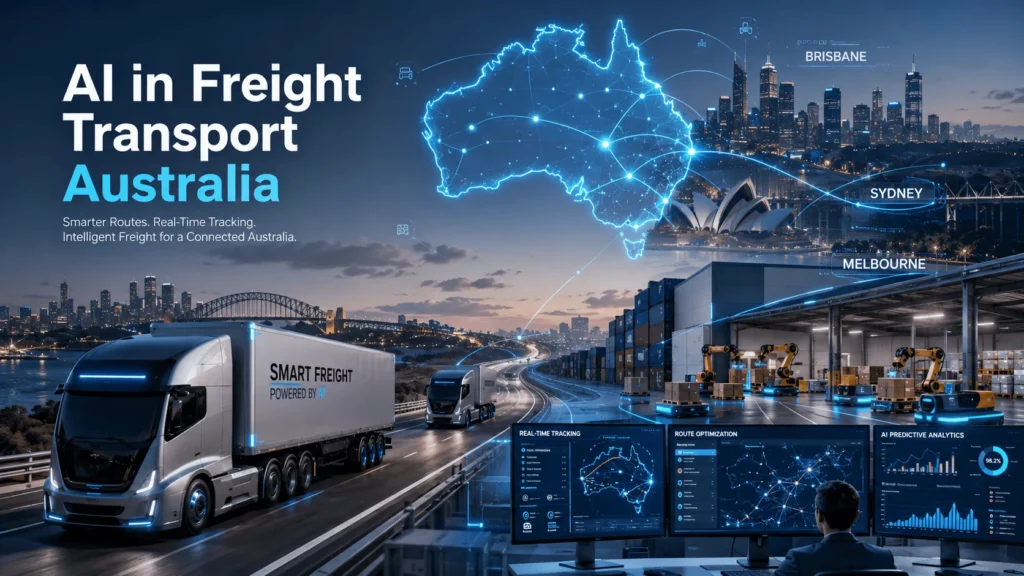
What is AI in Freight Transport?
Artificial Intelligence in freight transport refers to the use of advanced algorithms, machine learning, predictive analytics, automation systems, and intelligent software to improve logistics operations. AI systems collect and analyze data from vehicles, warehouses, GPS devices, customer orders, traffic reports, and supply chain networks to make smarter operational decisions.
AI technology is commonly used for:
- route optimization
- shipment tracking
- warehouse automation
- demand forecasting
- fleet management
- predictive maintenance
- inventory management
- customer service automation
Businesses using AI logistics Australia solutions can improve efficiency, reduce waste, and deliver goods more accurately than ever before.
Why AI is Becoming Important in Australian Freight Transport
The freight industry in Australia faces several unique challenges, including long transportation distances, rising fuel prices, labor shortages, increasing customer expectations, and complex supply chain operations. Traditional logistics systems often struggle to handle these challenges efficiently.
AI helps businesses overcome these issues by:
- improving route planning
- reducing fuel consumption
- minimizing delivery delays
- increasing shipment visibility
- automating repetitive tasks
- improving supply chain forecasting
For logistics companies operating between Sydney and Perth, AI can significantly improve transportation efficiency by identifying the most effective routes and predicting potential disruptions before they occur.
How AI is Transforming Freight Transport in Australia
Artificial Intelligence is no longer a futuristic concept. It is already being used by many logistics companies to improve day-to-day operations and long-term business performance.
- AI-Powered Route Optimization
One of the most important applications of AI in freight transport is route optimization. Traditional route planning often relies on static maps and manual decision-making, which can lead to inefficiencies and delays.
AI systems analyze:
- traffic conditions
- road closures
- weather patterns
- delivery schedules
- fuel consumption data
This allows logistics companies to select the fastest and most cost-effective delivery routes.
Benefits:
- lower fuel costs
- faster deliveries
- reduced travel time
- improved customer satisfaction
Companies providing freight transport Australia services are increasingly adopting AI-powered route optimization software to improve operational efficiency.
- Reducing Fuel Costs Through AI
Fuel expenses represent one of the largest operational costs in the logistics industry. AI helps businesses reduce fuel consumption by identifying more efficient routes and monitoring vehicle performance.
AI systems can:
- reduce idle time
- monitor driving behavior
- optimize vehicle loads
- improve delivery schedules
Benefits:
- lower transportation costs
- reduced emissions
- improved fleet performance
- increased profitability
For transport companies operating in Melbourne and Brisbane, fuel optimization can result in significant annual savings.
- Real-Time Shipment Tracking
Modern customers expect complete shipment visibility and delivery transparency. AI-powered tracking systems provide real-time updates throughout the transportation process.
Businesses can track:
- shipment locations
- estimated arrival times
- delivery progress
- route changes
- potential delays
Benefits:
- better customer communication
- improved transparency
- reduced customer complaints
- enhanced delivery accuracy
Real-time tracking has become a key feature of modern logistics services Australia.
- Warehouse Automation
Warehouses are becoming smarter through AI-powered automation systems. These technologies help businesses improve inventory management and order fulfillment processes.
AI can automate:
- inventory tracking
- stock management
- order processing
- product picking
- warehouse navigation
Benefits:
- faster order fulfillment
- reduced labor costs
- improved inventory accuracy
- fewer operational errors
Many logistics facilities in Sydney are investing heavily in warehouse automation to improve productivity and customer service.
- Demand Forecasting & Predictive Analytics
One of AI’s most valuable capabilities is predicting future demand. By analyzing historical sales data, market trends, seasonal patterns, and customer behavior, AI helps businesses forecast shipping requirements more accurately.
Businesses can:
- prepare for demand spikes
- optimize inventory levels
- reduce stock shortages
- improve supply chain planning
Benefits:
- better inventory control
- reduced storage costs
- improved operational planning
- stronger supply chain management
- Predictive Vehicle Maintenance
Unexpected vehicle breakdowns can cause delivery delays and increase operational expenses. AI-powered predictive maintenance systems monitor vehicle performance and identify maintenance needs before failures occur.
AI monitors:
- engine performance
- tire conditions
- fuel efficiency
- mechanical wear
Benefits:
- fewer breakdowns
- reduced repair costs
- improved fleet reliability
- better delivery performance
Predictive maintenance is becoming a critical component of modern transport services Australia.
- AI-Powered Customer Service
Customer support is another area where AI is making a significant impact. Logistics companies now use AI chatbots and automated communication systems to handle customer inquiries.
AI can provide:
- shipment updates
- delivery notifications
- estimated arrival times
- support assistance
Benefits:
- faster response times
- reduced support costs
- improved customer experience
- increased customer satisfaction
AI and Sustainable Freight Transport
Sustainability is becoming increasingly important for logistics companies across Australia. AI helps businesses reduce environmental impact by improving operational efficiency and reducing fuel consumption.
AI contributes to sustainability through:
- route optimization
- reduced fuel waste
- efficient fleet management
- lower emissions
- optimized warehouse operations
Businesses adopting green logistics Australia strategies often combine sustainability initiatives with AI-powered systems to achieve long-term cost savings.
How Major Australian Cities Are Adopting AI Logistics
Sydney
Sydney is leading AI adoption in freight transport, with logistics companies investing in smart tracking systems, automated warehouses, and advanced fleet management solutions.
Melbourne
Melbourne is using AI to improve interstate freight operations, warehouse automation, and supply chain efficiency.
Brisbane
Brisbane is becoming a growing hub for AI-powered logistics technology, particularly in transport management and distribution operations.
Benefits of AI in Freight Transport Australia
Key Advantages:
- reduced logistics costs
- faster deliveries
- improved route planning
- better fleet management
- enhanced customer experience
- increased shipment visibility
- reduced fuel consumption
- smarter inventory management
- improved operational efficiency
- stronger supply chain performance
Frequently Asked Questions
Q1. What is AI in freight transport?
AI uses advanced technology and data analysis to improve logistics operations, route planning, and shipment management.
Q2. How does AI reduce logistics costs?
It improves route efficiency, reduces fuel consumption, and automates repetitive tasks.
Q3. Can AI improve delivery speed?
Yes, AI optimizes routes and predicts delays to improve delivery performance.
Q4. Is AI used in warehouse operations?
Yes, AI automates inventory management, order processing, and warehouse workflows.
Q5. Which Australian cities are adopting AI logistics?
Sydney, Melbourne, Brisbane, and Perth are leading AI adoption in logistics.
Q6. Does AI help with sustainability?
Yes, AI reduces fuel waste, improves efficiency, and lowers emissions.
Final Conclusion
AI is transforming freight transport in Australia by making logistics operations smarter, faster, and more efficient. From route optimization and predictive maintenance to warehouse automation and real-time tracking, Artificial Intelligence is helping businesses reduce costs while improving customer satisfaction. As technology continues to evolve, companies that invest in AI-powered logistics solutions will be better positioned to compete in the future of freight transport. For businesses operating in Sydney, Melbourne, Brisbane, and across Australia, AI is no longer an option—it is becoming an essential part of modern logistics success.