
The logistics and warehousing industry in Australia is undergoing a major technological transformation. With e-commerce growth, customer expectations for faster deliveries, and increasing competition, businesses are adopting automation in warehouses to stay competitive.
From robotics and AI-driven systems to automated inventory management and smart picking technologies, automation is not just a trend—it is reshaping how warehouses operate across Australia.
This blog explores the impact of automation in warehousing, its benefits, current trends in Australian logistics, and why companies must embrace technology to thrive in a rapidly evolving supply chain environment.
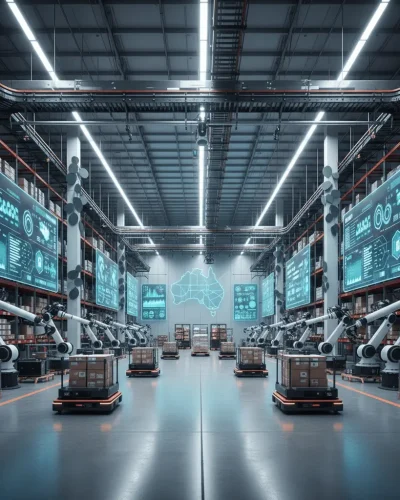
1. What is Warehouse Automation?
Warehouse automation refers to using technology to reduce human intervention in warehousing operations. It includes:
- Automated Storage and Retrieval Systems (AS/RS)
- Robotics for picking and packing
- Conveyor systems
- AI-powered inventory management
- IoT sensors and real-time monitoring
Automation streamlines warehouse processes, reduces errors, and ensures faster order fulfilment.
2. Why Automation is Becoming Essential in Australian Warehouses
a) Growing E-Commerce Demand
Australia’s e-commerce sector has exploded in recent years, with major players like Amazon, eBay, Kogan, and local retailers scaling up online operations.
Automation helps warehouses handle high order volumes efficiently, reducing delays.
b) Rising Labor Costs
Hiring and retaining warehouse staff in Australia is expensive due to:
- Skilled workforce shortages
- Minimum wage regulations
- High operational costs
Automated systems reduce dependency on human labor, improving cost efficiency.
c) Customer Expectations
Customers expect:
- Same-day or next-day delivery
- Real-time tracking
- Accurate order fulfilment
Automation ensures speed, accuracy, and consistency, which directly improves customer satisfaction.
d) Competitive Advantage
Warehouses using automation can process more orders, reduce operational costs, and scale quickly, giving companies a significant edge in the Australian market.
3. Key Types of Automation in Australian Warehouses
a) Robotics & Automated Picking Systems
Robotic arms and mobile robots (AMRs) can:
- Pick and pack orders efficiently
- Reduce human error
- Work 24/7 without fatigue
Example: Automated guided vehicles (AGVs) transport goods within warehouses, optimizing workflow.
b) Conveyor Systems
Automated conveyors reduce manual handling and speed up the movement of goods within large facilities.
c) Automated Storage and Retrieval Systems (AS/RS)
- Efficiently store and retrieve inventory
- Maximise warehouse space
- Reduce product damagd) AI-Powered Inventory Management
AI predicts demand, manages stock levels, and optimizes order allocation.
This reduces overstocking and stockouts, saving money.
e) Internet of Things (IoT) Sensors
IoT devices monitor:
- Temperature
- Humidity
- Equipment health
- Inventory movement
Real-time data enables better decision-making and proactive maintenance.
4. Benefits of Warehouse Automation
- Increased Operational Efficiency
Automated processes are faster and more accurate than manual operations, increasing order throughput.
- Reduced Human Error
Automation reduces picking and packing errors, improving order accuracy.
- Lower Labor Costs
Fewer staff required for repetitive tasks leads to cost savings.
- Better Space Utilization
Automation allows vertical storage and smarter layouts, maximizing warehouse space.
- Faster Order Fulfillment
Robotics and AS/RS systems speed up processing, supporting same-day delivery.
- Enhanced Safety
Automation reduces workplace accidents from heavy lifting, forklifts, and manual handling.
- Data-Driven Decisions
Real-time analytics from automated systems enable better inventory forecasting and demand planning.
5. Trends in Warehouse Automation in Australia
a) Smart Warehouses
Australian companies are adopting cloud-based warehouse management systems (WMS) integrated with AI, IoT, and robotics.
b) Collaborative Robots (Cobots)
Cobots work alongside human staff, handling repetitive tasks while humans focus on complex decisions.
c) Autonomous Vehicles
Automated forklifts and AGVs transport goods, reducing transit time inside warehouses.
d) E-Commerce Focus
Retailers are expanding warehouses with automation specifically for high-volume e-commerce fulfilment.
e) Sustainability
Automation optimizes energy usage, reduces waste, and minimizes carbon footprint.
6. Case Studies of Warehouse Automation in Australia
- Amazon Australia
- Uses robotics in Melbourne and Sydney fulfilment centres
- Automated picking and sorting increase speed and accuracy
- Woolworths Distribution Centres
- Implements automated palletising and AI-driven inventory management
- Improved order throughput and reduced operational costs
- Kogan Fulfilment Centres
- Uses conveyor and sorting automation
- Faster dispatch for online orders
These examples demonstrate how automation helps scale operations, reduce costs, and improve delivery timelines.
7. Challenges of Implementing Automation
a) High Initial Investment
Automation requires significant capital expenditure.
b) Training & Workforce Adaptation
Staff must be trained to operate and maintain automated systems.
c) System Integration
Integrating new automation with legacy systems can be complex.
d) Maintenance Costs
Automated equipment requires regular maintenance to avoid downtime.
Despite challenges, long-term benefits often outweigh initial costs.
8. Future of Warehouse Automation in Australia
- AI-powered predictive analytics for smarter inventory
- Fully autonomous warehouses with minimal human intervention
- Green warehouses using automated energy optimization
- Integration with supply chain partners for seamless logistics
Automation is expected to become standard in Australian warehousing over the next decade.
Conclusion
Warehouse automation is no longer optional—it is essential for companies seeking efficiency, scalability, and competitiveness in Australia’s logistics industry.
By adopting robotics, AI, IoT, and smart management systems, businesses can:
- Process more orders faster
- Reduce errors and labor costs
- Maximise warehouse space
- Ensure better customer experience
Australian warehouses embracing automation are setting new standards for speed, accuracy, and sustainability in the supply chain.
Frequently Asked Questions
Q1: What is warehouse automation?
Warehouse automation uses technology like robotics, AI, and IoT to streamline operations with minimal human intervention.
Q2: Why is automation important in Australian logistics?
It increases efficiency, reduces labor costs, improves accuracy, and supports faster delivery.
Q3: What types of automation are used in warehouses?
Robotics, AS/RS systems, conveyors, AI inventory management, and IoT sensors.
Q4: What are the benefits of warehouse automation?
Higher efficiency, lower errors, cost reduction, better space utilization, and faster fulfillment.
Q5: Are automated warehouses expensive to set up?
Yes, initial investment is high, but ROI is achieved through long-term efficiency gains.