
Choosing the right transport method is one of the most critical decisions for any business operating in Australia. Whether you run an eCommerce store, a manufacturing unit, or a wholesale distribution company, your logistics strategy directly affects delivery speed, operational costs, and customer satisfaction.
Australia’s vast geography and well-developed infrastructure make it essential to understand the differences between road transport, rail transport, and sea transport. Each option comes with its own advantages, limitations, and ideal use cases.
In this detailed guide, we will compare all three transport modes to help you decide which is best for your business needs.
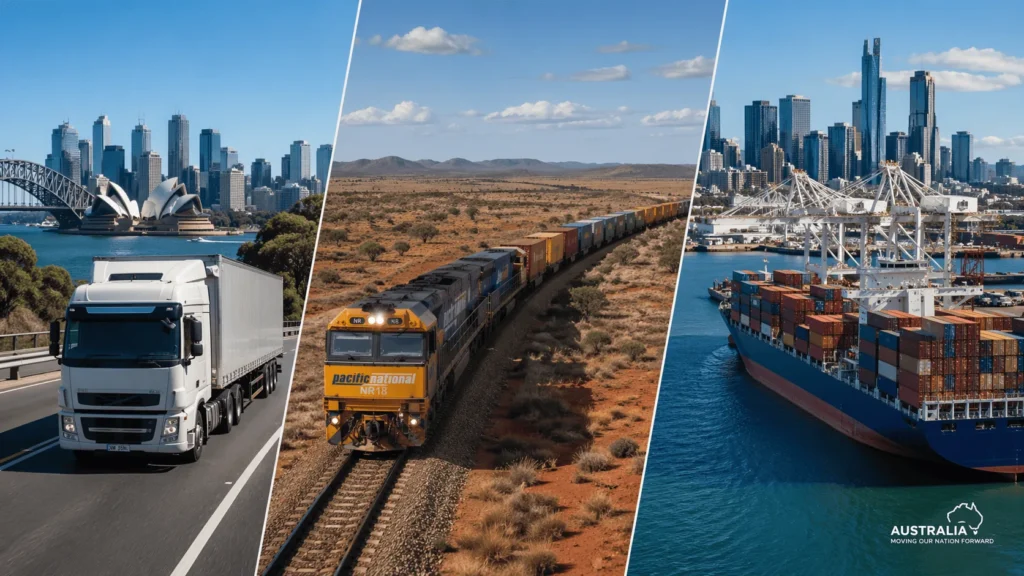
Overview of Transport & Logistics in Australia
Australia has a highly advanced logistics network, especially in major cities like:
- Sydney
- Melbourne
- Brisbane
- Perth
These cities serve as major hubs for freight transport services, supply chain operations, and logistics solutions in Australia.
1. Road Transport in Australia
What is Road Transport?
Road transport involves moving goods using trucks, vans, and trailers via highways and local roads across Australia.
Advantages of Road Transport
- Door-to-Door Delivery:
Road transport provides complete pickup and delivery solutions without the need for additional handling. - Fast for Short Distances:
Ideal for routes between cities like Sydney and Melbourne. - Flexible Routing:
Routes can be adjusted based on traffic, urgency, or delivery requirements. - Essential for Last-Mile Delivery:
Critical for eCommerce logistics and courier services.
Disadvantages of Road Transport
- Higher fuel and operational costs
- Traffic congestion can cause delays
- Not cost-effective for long-distance bulk transport
Best Use Cases
- Local deliveries
- Retail distribution
- eCommerce shipping
- Perishable goods transport
2. Rail Transport in Australia
What is Rail Transport?
Rail transport uses trains to move goods across long distances between cities and states.
Advantages of Rail Transport
- Cost-Effective for Bulk Freight:
Ideal for transporting large volumes at lower costs. - Environmentally Friendly:
Lower carbon emissions compared to road transport. - Reliable for Long Distances:
Less affected by road traffic and weather conditions.
Disadvantages of Rail Transport
- Limited flexibility due to fixed routes
- No door-to-door delivery
- Requires road transport for first and last-mile connectivity
Best Use Cases
- Mining and raw materials
- Industrial goods
- Bulk freight transport
- Intercity logistics
3. Sea Transport in Australia
What is Sea Transport?
Sea transport involves shipping goods via cargo ships between ports, both domestically and internationally.
Advantages of Sea Transport
- Most Cost-Effective for Large Shipments:
Best option for bulk cargo and international trade. - High Capacity:
Can carry massive volumes of goods. - Global Reach:
Essential for import-export businesses.
Disadvantages of Sea Transport
- Slow delivery times
- Weather and port delays
- Additional handling and customs processes
Best Use Cases
- International shipping
- Heavy machinery transport
- Bulk exports and imports
Road vs Rail vs Sea Transport – Comparison Table
Factor | Road Transport Australia | Rail Transport Australia | Sea Transport Australia |
Speed | Fast (short distances) | Moderate | Slow |
Cost | Medium to High | Low (bulk) | Lowest |
Flexibility | High | Low | Medium |
Coverage | Door-to-door | Limited stations | Port-to-port |
Best For | Local delivery | Bulk goods | International shipping |
How to Choose the Right Transport for Your Business
When selecting the best transport method, consider the following factors:
Delivery Speed
- Choose road transport for faster deliveries over short distances
Budget Constraints
- Opt for rail or sea transport for cost efficiency in bulk shipments
Shipment Type
- Perishable or urgent goods → Road
- Heavy or bulk goods → Rail
- International cargo → Sea
Flexibility Needs
- Road transport offers maximum flexibility
Smart Logistics Strategy (Multi-Modal Transport)
Modern logistics companies in Australia are increasingly adopting multi-modal transport solutions, combining:
- Road + Rail
- Rail + Sea
- Road + Sea
Benefits:
- Reduced costs
- Faster delivery times
- Improved efficiency
- Better supply chain management
Frequently Asked Questions
Q1. Which transport is the cheapest in Australia?
Sea transport is the most cost-effective, especially for large shipments.
Q2. Which transport method is the fastest?
Road transport is usually the fastest for short to medium distances within Australia, especially between major cities like Sydney, Melbourne and Brisbane.
Q3. What is best for international shipping?
Sea transport is best for international shipping, particularly for large, heavy or bulk cargo moving in and out of Australian ports.
Q4. Is rail transport reliable in Australia?
Yes, it is highly reliable for long-distance and bulk goods transport.
Q5. Which transport is best for eCommerce businesses?
Road transport is best for last-mile delivery and fast shipping.
Q6. Can businesses use multiple transport methods?
Yes, multi-modal logistics is the most efficient approach today.
Final Conclusion
To simplify:
- Road Transport → Fast, flexible, best for short distances
- Rail Transport → Cost-effective, ideal for bulk freight
- Sea Transport → Best for international shipping and large volumes
✔ Short-distance delivery → Road
✔ Bulk domestic transport → Rail
✔ Global shipping → Sea